Atomic Habits
The surprising power of atomic habits
After years of disappointment, the British cycling team's management made the decision to bring in a new coach. The man they chose was Dave Brailsford, who went on to introduce a transformative strategy known as the "aggregation of marginal gains." At its core, this philosophy is built on the idea that continuous small improvements, when combined, can lead to extraordinary results. Rather than overhauling an entire system at once, you break it down into its individual components and focus on making incremental improvements to each one.
Think of it this way. Imagine a boat made up of 500 parts, each serving its own unique purpose. Improving just one part by one percent would have a barely noticeable impact on the boat's overall performance. Even improving two, five, or ten parts may not seem significant. However, as you work through each component, you would theoretically end up with a boat that operates far beyond its original capacity.
This is precisely what good habits can do for us. A single daily habit, such as going to the gym, may feel completely ineffective on day one. But over time, the results begin to speak for themselves. Radical overnight change rarely delivers the outcome we hope for. It is the steady accumulation of small, consistent improvements that ultimately produces remarkable results.
So what does this mean for you as a reader?
As you work toward your goals, progress may not always be visible straight away, and that is completely normal. Do not give up. The defining difference between those who achieve their goals and those who are left feeling defeated is the refusal to quit. Be resilient. Be persistent. Embrace perseverance. It is your discipline, consistency, and mental strength that will carry you forward in every area of your life. Your actions compound over time, and whether that compounds in your favour or against you is entirely within your control.
How your habits shape your identity
When people try to change habits they usually make a temporary change. However, after a few days or even weeks that new habit you said you were going to develop eventually becomes a chore and we fall back into our old habits. The reason for this is because we change our habits in the wrong way. We think that one radical change will lead to developing new habits but it isn't. It is the systems and habits we develop that help us achieve our desired state. E.g. If you muster up the energy to clean your room after it has been messy for a while, you'll eventually find yourself back to having a messy room because you still have the habits of a lazy person.
Ultimately, there are three layers as to how your habits shape your identity.
1st layer - Outcomes: This level is concerned with changing your results: losing weight, publishing a book, winning a championship. Most goals you set are associated with this layer.
2nd layer - Processes: This level is concerned with changing your habits and systems: implementing a new routine at the gym, decluttering your desk for better workflow, developing a meditation practice. Most of the habits you build are associated with this level.
3rd layer - Identity: This level is concerned with changing your beliefs: your worldview, your self-image, your judgement about yourself and others. Most of the beliefs, assumptions, and biases you hold are associated with this level. Many people begin the process of changing their habits by focusing on what they want to achieve. This leads them to outcome-based habits. The better alternative is to build identity-based habits. With this approach, we focus not on what we want to achieve, but who we wish to become!
As an example, the goal is not to clean your room, the goal is to become a clean person. The goal isn’t to run a marathon, the goal is to become a runner. The goal isn’t to learn how to play a new instrument, the goal is to become a musician. When we change our outcome-based habits to identity-based habits we associate that habit with our identity which makes them easier to stick to. Because they are no longer what we want, but they represent who we are.
A way to do this is (1) decide the type of person you want to be and (2) prove it to yourself with small wins. As mentioned in the previous paragraph every small win eventually adds up.
The four steps of how habits are built
Cue: The cue triggers your brain to initiate a behaviour. It is a bit of information that predicts a reward. Our prehistoric ancestors used these cues to signal them towards primary rewards like food, sex, and water. Today, we spend most of our time learning the cues that predict secondary rewards like fame, money, power, and approval. The cue is the first indication of a reward, which leads us to a craving.
Craving: A craving is the motivational force behind every habit. Without a craving to change we have no reason to act. It is not the habit you crave but the change in state it delivers. E.g. you do not crave smoking, you crave the sense of relief it provides.
Response: The response represents a thought or action. It is the actual habit you perform. Whether a response occurs depends on how motivated you are and how much friction is associated with that habit. If an action requires more physical effort than you are willing to expend then you won't do it.
Reward: Rewards are the end goal of every habit.
In hindsight, we chase rewards because they satisfy us and they teach us. They satisfy us in the sense that food and water (habit = eating) provide us with energy to live (reward). Getting a promotion (habit = working hard) gets us more money and respect (Reward). They also teach us in the sense that once we receive a reward our brain automatically associates positive reinforcement with that action so we are more likely to repeat it.
1st law - Make it obvious
The first step is self awareness
After years of routinely performing tasks they eventually become habitual, and the concept of cues I mentioned in the previous paragraph become instinctive. We do things without noticing. This can be a good thing but it can also be a bad thing. The first step to changing our habits is seen in the 1st law. We gotta make it obvious. So becoming self aware around your habits is very important. Tips to become more self aware is literally saying it aloud. This raises your habits from the unconscious realm to the conscious realm. Another tip is a habit scorecard. On a piece of paper, write down your current daily habits. If it is a positive habit place a + next to it, and if it is a negative habit place a - next to it. Once finished, create a plan as to how you can eliminate the habits that don't contribute to your desired self.
The best way to start a new habit
A good way to start a new habit is to use the habit stacking formula.
After (Current habit), I will (New habit). For example:
If you want to add meditation into your life. After I pour my cup of coffee each morning (Current Habit), I will meditate for 5 minutes (New Habit).
Exercise. After I take off my work shoes (Current habit), I will immediately change into my workout clothes (New Habit).
The key is to tie your desired behaviour with something you do everyday. Once you get more comfortable with this you can begin stacking each one on top of eachother. Lets say your daily habit is to drink coffee and your desired habit is too complete a to do list your habit stacking list can look like this:
After I drink my morning coffee, I will meditate for five minutes.
After I meditate for 5 minutes, I will write down my to-do list for the day.
After I write my to-do list, I will immediately begin my first task.
Make sure it is specific and at a reasonable time. If you want to exercise in the afternoon but you normally have classes then switching it to the morning may be the better alternative. If you want to meditate after work but you're usually tired by then, then meditating in the morning may be the better alternative. This will mitigate risk of distraction and inconsistency.
Your environment matters more than you think
A researcher named Edward Lee Thorndike once conducted an experiment to determine different behaviours towards purchasing products. Before the experiment there were many soda stalls in a cafeteria for people to select from. However, during Thorndike's experiment he swapped the soda stalls out for bottled water stalls. As a result, soda sales decreased by 11.4% and bottled water sales increased by 25.8%. This is a good example for this section. Your environment. Many old habits continue to happen because of the environment we are in. If you're at a bar you're more likely to drink, if you're on your phone during study you’re less likely to get anything done. However, this works for good habits as well. If you do your weekly shopping you’re less likely to eat takeaways. In hindsight, motivation and willpower can only do so much. But if you are constantly bombarded by cues in your environment that negatively affect your goals for new habits you will eventually give in. So eliminating these negative cues in your environment is very important.
A quote by James Clear that reinforces this point is when he states: “In the short-term, you can choose to overpower temptation. But in the long-run you become the product of your environment”.
What we can do is make the cues of good habits obvious in your environment. If you are trying to get work done at your desk, leave your phone in the other room. If you keep forgetting to take your vitamins that are in your pantry, leave them out on the kitchen bench. When we make the cues obvious for us to complete our desired habit we are more likely to continue doing it.
More examples:
If you’re continually feeling like you're not enough, stop following social media accounts that trigger jealousy and envy.
If you’re wasting too much time watching television, move the TV out of the bedroom.
If you’re playing too many video games, unplug the console and store it in your closet after each use.
Apply this strategy to your life accordingly.
2nd Law - Make it attractive
How to make a Habit irresistable
The second law of Atomic Habits is simple yet powerful: make your habits attractive. To understand why this matters, we first need to explore a concept known as the dopamine driven feedback loop.
Dopamine is a neurological chemical found within the brain's pleasure centres. In simple terms, it is the primary source of the pleasure and motivation we experience on a daily basis. Our brains are fundamentally wired to seek it out. When dopamine levels rise, we feel compelled and motivated to take action. When they drop, we feel disengaged, unmotivated, and unlikely to follow through on anything. Understanding this is crucial, because if we want to build good habits that actually stick, we need to find ways to increase our dopamine response when engaging in those habits. In other words, we need to make the habit feel attractive enough that our brain genuinely wants to pursue it.
So to form good habits, is to formulate a method that increases our dopamine when we complete the good habit we wanted. Ultimately “making the habit MORE ATTRACTIVE”.
Now, according to a study in the text our dopamine increases when we receive a reward but it increases the most at the anticipation of a reward. For example, before opening a text or snapchat our dopamine spikes the most. A cocaine addict gets a surge of dopamine when they see the powder, not when they take it. Gambling addicts' dopamine spikes right before they place a bet, not after they win. Whenever you predict an opportunity to give you a reward, your levels of dopamine spike in anticipation. We can use this information to form good habits and with this knowledge in mind, there is a method called habit stacking + temptation bundling.
After (Current habit), I will (Habit I need).
After (Habit I need), i will (Habit i want)
For example if you want to play fortnight, but need to exercise daily.
After I have have a coffee (current Habit), I will exercise for 45 minutes (Habit I need).
After I exercise for 45 minutes, I will play fortnight for 1 hour (Habit I want).
The role Family and friends play in shaping your habits
For the history of mankind human beings have always conformed to the masses because they simply wanted to belong. A sense of belonging is one of human kind's deepest desires. In the early ages being evicted from your tribe or clan was pretty much seen as a death sentence, and as our species have evolved we see it continued into contemporary society. We don't choose our earliest habits, we imitate them. We follow the script handed down to us by our friends and family, our church or school, our local community and society at large. Each of these cultures come with it’s own set of expectations and standards. What sport you play, what you eat, how you talk or converse, or even when you get married. These social norms are the invisible rules that guide our lives even if they are not at the top of our mind. We do them instinctively.
We imitate three groups in particular:
The close ( Friends and family)
The many ( Society, sports groups, or communal groups).
The powerful (Celebrities, presidents, the rich).
In a study by a psychologist named Solomon Asch he concluded that 75% of people would rather be wrong and fit in with the crowd, than be right or seek the truth and go against the crowd as it makes them uncomfortable. What does this have to do with building good habits you may ask? Well, when changing your habits means challenging the crowd, change is unattractive. When changing your habits means fitting in with the crowd, change is very attractive. So the real question is. What old habits are you tryna break out of? What new habits are you trying to build? and does your environment allow you the possibility to positively change?
Tip to make your new habits more attractive:
Join a social culture where (1) your desired behaviour is the normal behaviour and (2) you already have something in common.
Nothing sustains motivation longer than belonging to a tribe. It transforms a personal quest into a shared one. Before you were on your own. Your identity was singular. You are a reader. You are a musician. You are an athlete. But when you join that book club, music class, or sports team. Then the “you” becomes “we”. Motivation is longer sustained. We are readers. We are musicians. We are athletes.
How to find and fix the causes of your habits
Where do cravings for habits come from?
Well, your habits are modern day solutions to ancient desires. What does this mean? Well you see, our ancient desires were to (conserve energy, obtain food and water, find love and reproduce, connect and bond with others, win social acceptance and approval, reduce uncertainty, achieve status and prestige). In a modern context this is what we do now. To find love and reproduce = We use tinder. To connect and bond with others = Facebook. To gain social acceptance = Posting on instagram. To achieve status and prestige = playing video games.
Although each person may have a different solution for each motive, the truth is that the underlying motivation for everything we do remains the same. When we understand this, we realise that everything we do is simply to solve a problem in our life. Im feeling stressed out = Okay i'll binge watch a netflix series. I'm feeling anxious = Okay i’ll watch youtube to distract myself. Understanding this concept leads to greater self awareness and when you feel obliged to do something, it is important you realise to yourself. What motives am I trying to fulfill now?
3rd Law - Make it easy
Repetition is key
This section talks about how people say they will do things, plan, learn but never actually get anything done. They say they will start their new podcast, they talk to their personal trainer about what's the best training plan but they never actually do it. This is called motion. However, what James Clear advocates for is taking action. The more repetitions you get in the more likely you’ll build the habit. Habit formation is the process by which a behaviour becomes progressively more automatic. Therefore, the more you take action. The more repetitions you complete. Your brain’s neurological pathways will associate that with a particular behaviour more comprehensively.
The law of least effort
Human behaviour follows the law of the least effort. We will naturally gravitate toward the option that gets us the best result for the least amount of effort. Every action requires a certain amount of energy. The more energy required, the less likely it is to occur. If we look at any of our mundane habits we can see that they are the habits that require little motivation. Habits like scrolling through our phones, checking emails, and watching television. These habits steal so much time away from our lives. Yet, we continue to perform them. Good habits such as going to the gym, meditating, reading books, practicing gratitude. These habits require a lot more energy to perform which is called friction. Hence, why we always slip back into our old habits.
A step towards reconciling this is to modify our environment. As mentioned in chapter 6 our environment can play a huge factor whether or not we stick to good habits. What we can do is modify our environment to decrease friction. Too often, we try to start habits in high-friction environments. We try to stop drinking, while out at a bar with friends. We try to meditate in a chaotic household. We try to concentrate during study, while our smartphone with many distractions sits in our pocket. A method used in the book is called addition by subtraction. This is when you look at every point of friction that's stopping you from achieving a desired result in an environment and eliminating it. If we look at the most-habit forming products, what they do so well is remove friction from our lives. Meal delivery services reduce the friction of grocery shopping. Dating apps reduce the friction of social introductions. This method is seen all over the world, but how we use it is entirely up to us.
What we also can do is increase the friction for bad habits. For example, after you finish watching your favorite TV show unplug the TV and take the batteries out of the remote. When you come into the lounge the next time the friction to watch TV again is increased.
Two minute rule to mitigate procrastination
Twyla Tharp is widely regarded as one of the greatest dancers and choreographers of the modern era. Following this she attributes her success to her daily morning ritual. She wakes up at 5.30 a.m. every morning then puts her workout clothes on, her leg warmers, sweatshirt, and hat. She then walks outside of her house in Manhattan and catches a taxi cab to the gym. The ritual is not stretching and weight training at the gym; the ritual is actually the cab. “The moment I tell the cab driver where to go I have completed the ritual” she says. Her desired result is of course the stretching and weight training but her completion of the morning ritual ensures that she does them. If she slept in, didn't get out of the house, or didn't catch the taxi cab the productivity of her day would be ruined.
People often look at the end result of completing their habit but if we break the habit down into its first two minutes we are more likely to follow through. This is because human psychology tells us that if we start something we are more likely to keep going. For example, if the habit is to read 1 hour a night, start by getting comfortable and reading one page. If the goal is to workout more, start by putting your gym clothes on. If the goal is to go for a run, start by lacing up your running shoes. If we focus on the easy steps, or ritualizing the first two minutes of a habit we will likely be led to more success. I'll leave you with a quote:
“The more you ritualize the beginning of a process, the more likely it becomes that you can slip into the state of deep focus that is required to do great things”.
Make good habits inevitable, and bad habits impossible
This chapter is called “Make it easy”. But the inversion of this law is to “make it difficult”. As mentioned in previous sections the friction of performing an action usually determines whether or not we do it. A method to enhance this is called a Commitment device. Essentially, a commitment device is a choice you make in the present that controls your actions in the future. Commitment devices enable you to take advantage of good intentions before you fall into temptation. For example: if you're feeling motivated to get in shape, schedule a yoga session, and pay ahead of time. If you’re excited about a business you want to start, email an entrepreneur you respect and set up a consulting call, if you want to save more, set up an automatic payment plan. The key is to change the task such that it requires more work to get out of the good habit than to get started on it.
4th law - Make it satisfying
The cardinal rule of behaviour change
The first three laws of behaviour change - make it obvious, make it attractive, make it easy - increase the odds a behaviour will be performed. The fourth law of behaviour change - make it satisfying - increases the odds that a behaviour will be repeated.
The world our homo sapien ancestors lived in was simple. On any given day, most of their decisions had an immediate impact. They were always thinking about what to eat, where to sleep, or how to avoid a predator. They lived in what scientists call an immediate-return environment. In today’s modern society, many of the choices we make today don't benefit us immediately. If we exercise, perhaps we won't be overweight next year. If we work hard at work, we’ll get a paycheck next week. We live in what scientists call a delayed-return environment because we can work for weeks or years before our actions deliver the intended result. It’s only during the last couple hundred years or so that our society has shifted to a predominantly delayed-return environment. In the last one hundred years, we have seen the rise of the car, the airplane, the internet, and the smartphone. Our ancestors were focused on responding to great threats, and securing the next meal. Their distant future was of less concern. And after hundreds of thousands of years of living in an immediate-return environment, our brains evolved to prefer short-term pleasures over long ones. Unfortunately, our brain wasn’t wired for a delayed-return environment because we still have the brain chemistry as our paleolithic ancestors. What does this mean? Well, this is largely why our entire society craves instant gratification.
Bad habits have become more rewarding immediately and good habits have become more rewarding later. This is the reason why people smoke. Overeat. Or browse through their phone too much. Smoking may decrease your life expectancy in the long-run, but it reduces stress and eases your nicotine cravings NOW. Overeating is harmful in the long-run but appetizing in the moment. Browsing on your phone wastes thousands of hours overtime, but is pleasing when you're bored. If we follow the mentioned tips in the previous pages you’ll be helped to avoid this. But understanding instant gratification is critical towards improving your self awareness.
How to stick with good habits every day
The fourth law of behaviour change is - make it satisfying. You’ve got to make your good habits feel good so you repeat them. A method to help with this is to track your habits.
One of the most satisfying feelings is seeing progress as it provides clear evidence of your performance. Although this seems easy, many people struggle to stay consistent with tracking their habits. A rule of thumb for this to be effective is to not miss two days in a row. American business man Charlie Munger calls this “breaking the chain”. Life can get in the way sometimes so missing one day is understandable, but you must be disciplined to not let yourself miss more than two days as you can fall into a downward spiral. Even if you don't feel like it. The ability to stay consistent and disciplined even on your “Off” days is often what separates the great people from the good.
Another tip for when tracking your habits. Don’t track the outcome. Obviously, the intended outcome of your new habits building is good to set as a milestone. However, this can become toxic if we rely too heavily on the outcome. Instead focus on your process to achieve your desired result. And remember to be grateful for your life, enjoy the small daily wins, and enjoy the process.
Accountability partner
A way to avoid bad habits is to make them unsatisfying. And we can do this by applying an immediate punishment for inaction. This method is called a habit contract. I know you're thinking that this is over the top. But for habits like not drinking for a while. Working out daily for a couple months. Or meditating daily for the next month. A habit contract may seem feasible.
The idea of this is to write a contract with someone you trust, stating that if you do not follow these rules you must be punished. For example, if you want to stop drinking for an 8 week challenge coming up. Write a contract stating that if you drink you must pay your partner $500 dollars. And put your signature at the bottom of it. This will create an immediate pain for inaction of your desired new habits.
Advanced tactics
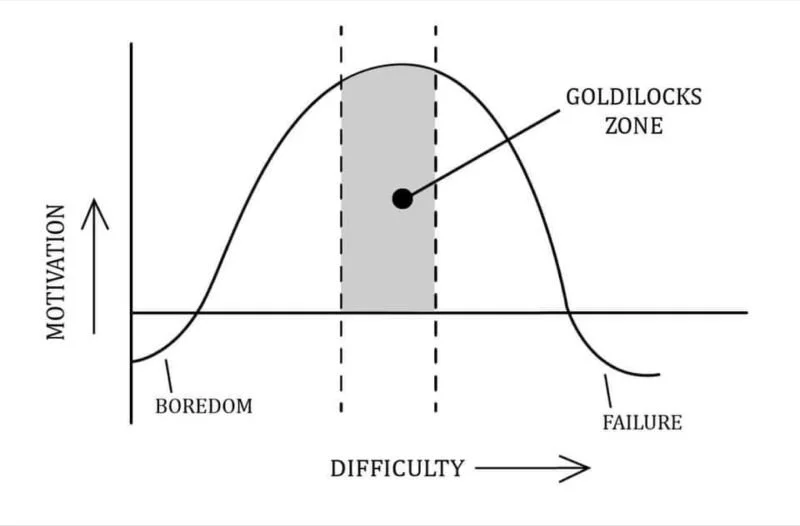
As we wrap up this book a few advanced tactics are mentioned in the book. One tactic that resonated with me is a concept called the goldilocks zone.
The key to achieving the goldilocks zone is to do something that is slightly out of your current ability but can be achieved with hard work. If a task is too easy you will lose motivation and get bored. And if a task is too difficult you will get discouraged and likely stop. So finding the right balance keeps you on edge. And as progress occurs, you continue to gain incremental rewards which keeps you motivated. If a person can find an activity that they enjoy and command some sort of competency in, then achieving the goldilocks zone can help them become great in whatever they choose.
This zone essentially represents the ‘Flow state’. This is a state where someone is intentionally focused on a task that they do. It’s when a person doesn't have to think about an action they simply do. Relating it to habits, this zone pushes people to strive for excellence in their fields by continuing their habits.
Conclusion
If you have made it this far, I believe you are someone who is genuinely motivated to build better habits or improve certain areas of your life. That alone already puts you ahead of most people. The book this report is based on genuinely changed my life when I first came across it in 2021. I actually read and reviewed the book back then. This is simply the revisited and remastered version so to speak. It is filled with real, practical, and deeply insightful knowledge that I believe anyone, regardless of where they are in life, can benefit from. With that said, stopping here would truly be doing yourself a disservice. If you are serious about building meaningful and lasting habits, I strongly encourage you to read the full book and immerse yourself in its details. This book is probably one of the best i’ve ever read.
The main truth I got from this book is that building good habits is the very foundation upon which freedom and success are built. It is what separates those who live intentionally from those who simply drift through life reacting to whatever comes their way. As world renowned marathon runner Eliud Kipchoge once powerfully said, "A man without discipline is a slave to his own choices."
If you have made it this far, and still don’t know where to start. I’d suggest to begin by identifying something you genuinely enjoy and have at least a natural inclination toward. It does not have to be something you are exceptional at right away. From there, begin building habits and discipline around it. Show up consistently, even when motivation fades, because motivation is temporary but discipline is lasting. I promise that with time, patience, and genuine effort, you will cultivate a life that feels not only more productive but more intentional, more fulfilling, and entirely more your own.
The path forward is yours to choose.
Thank you for reading.
References:
Atomic Habits
Clear, J. (2018). Atomic Habits: An Easy & Proven Way to Build Good Habits & Break Bad Ones. Avery.